
Ranjani Shettar and Alwar Balasubramaniam at the 2026 Venice Biennale
Shreela Ghosh, CWIT's Secretary has been visiting the Venice Biennale since 2005. Shreela remembers the excitement of the very first India Pavilion at the Biennale in 2011, curated by Ranjit Hoskote. In September 2026, before setting off for Venice, Shreela talked with curator and critic Shalmali Shetty (CWIT alumna) regarding her impression of the 61st edition of the Venice Biennale - the world's largest art exhibition. Shreela then decided to commission Shalmali to write about the India Pavilion 2026, with a specific focus on the work of artists Alwar Balasubramaniam and Ranjani Shettar; both these artists had received support from CWIT twenty years ago to develop their practice.

Ranjani Shettar’s Under the same sky, Pavilion of India at the 61st International Art Exhibition – La Biennale di Venezia
From Early CWIT Residencies to the Venice Biennale 2026: Alwar Balasubramaniam and Ranjani Shettar
By the time I reach the far end of the Arsenale’s industrial volume, I am laden with the accumulated weight of the unresolved conversations surrounding art’s political agency versus its institutional complicity. With the 61st Venice Biennale caught directly in the crosshairs of global politics, there is a palpable anxiety running through these halls. Set within the thematic frame of In Minor Keys, the biennale makes a contentious attempt to posthumously honour Koyo Kouoh’s artistic direction against the complex machinery of nation-state optics.
"A national pavilion inevitably speaks within a national context, but it can do so most meaningfully by giving artists the space to articulate nuanced and sometimes difficult experiences”
Dr. Amin Jaffar
Turning into the next gallery, the India Pavilion materialises in the low light, its spectacular installations slowly looming into view. After a seven-year hiatus, the pavilion marks an ambitious, freighted return to this global stage. Titled Geographies of Distance: Remembering Home and curated by Dr. Amin Jaffer, the exhibition presents large-scale installations by five artists who deploy traditional material cultures across thread, bamboo, papier-mâché, clay, and fabric to articulate contemporary realities.
Suspended between construction and dissolution, these works physically reassemble an ephemeral memory of home. One enters through Asim Waqif’s eruptive bamboo and rope structure anchored to the site's architecture. Facing this, Alwar Balasubramaniam’s wall of fissured earth sits adjacent to Ranjani Shettar’s sprawling, sinuous foliage. Across the room, Sumakshi Singh’s gossamer thread conjures the ghostly skeleton of a wistful dwelling, while on the upper level, Skarma Sonam Tashi’s papier-mâché houses evoke the high-altitude vernacular architecture of Ladakh.
"A national pavilion inevitably speaks within a national context,” Jaffer shares, “but it can do so most meaningfully by giving artists the space to articulate nuanced and sometimes difficult experiences rather than reducing them to a single official narrative.” Jaffer frames the site as a modest sanctuary that feels “intimate, elegiac and introspective”, steering away from the global surge towards digital spectacle. Informed by his upbringing in the Indian diaspora, where family memory was preserved through the language, food, and rituals of the subcontinent, the exhibition stems from a personal inquiry into how one claims a place when its physical terrain disappears. Drawing on his background in decorative arts and historical interiors, Jaffer treats this physical vulnerability as central to how "objects survive, deteriorate, migrate and acquire new meanings over time”, where fragility is not aestheticised but “is integral to what the artists are saying.”
Standing in Venice, a city built on centuries of empire, trade, and extraction, and now facing a steady disintegration under sea level rise and climate change — there is an inherent paradox in staging a collective mourning of past, present, and future. As news of another atrocity breaks daily, and as India itself navigates internal polarisation along religious, caste, class, and gender lines, what does a national presentation of "home" perform on an international stage? Whose home and homeland is being summoned? What does this search for belonging mean to the diaspora, the migrant, the refugee, those rendered strangers and ghosts within their own borders, and the ecologies uprooted alongside them?
“Positioned today at the height of their international careers, both artists share a foundational chapter: over two decades ago, each received a Charles Wallace India Trust award”
My focus turns to the contributions of two participating artists: Alwar Balasubramaniam and Ranjani Shettar. Positioned today at the height of their international careers, both artists share a foundational chapter: over two decades ago, each received a Charles Wallace India Trust (CWIT) award to undertake formative residencies in the UK: Balasubramaniam at Edinburgh Printmakers in 1997, and Shettar at Gasworks, London, in 2004. Today, both are also represented by Talwar Gallery (New York, New Delhi). Writing as a fellow CWIT alumna reflecting on their practices across a generational interval, we spoke about the necessity of early professional grants in India, the impact of cross-cultural exchanges, and their artistic trajectories towards representing the country at the world’s oldest art biennale, which continues until 22 November 2026.
Alwar Balasubramaniam
CWIT Arts Fellowship Award 1997
In 1997, a twenty-five-year-old Alwar Balasubramaniam — who friends call Bala — boarded a train from Chennai to New Delhi for his CWIT interview, to secure a one-year residency at Edinburgh Printmakers. Traveling outside India for the first time, Scotland offered a starkly different landscape: a colder climate, a quietness, and a slower pace of time (so much that he accidentally stayed an extra year in the UK!), which still echoes through his pensive, philosophical manner of speaking. He fondly recalls the lasting friendships, most notably with Dr Frank Taylor, Secretary of CWIT between 1993 and 2003, who sadly passed away in May of this year. When Bala had once asked how he could ever repay his kindness, Taylor responded that a river never flows back to its source on the mountain, but moves forward to feed the world in different ways. With this advice, Bala went on to build a local school in his ancestral village near Tirunelveli in Tamil Nadu, as a gesture of that forward-flowing generosity.
“Home is not just for us; earth is not only for human beings. Beyond political disagreements and borders, once we realise it is not just for us, a natural connection happens. Homeland belongs to everything at once.”
In 1999, while studying in Vienna, Bala visited the Venice Biennale for the first time. Noticing the absence of Indian representation in what was heralded as a global stage for art, he wrote a letter to Harald Szeemann, curator of that year’s edition. To his surprise, Szeemann responded, hoping India would one day hold a permanent pavilion at the biennale. It took until 2011 for Ranjit Hoskote to curate India’s official debut, and 2026 for Bala to stand within it.

Alwar Balasubramaniam - Not Just for Us [image Andrea Avezzù]
Bala’s two-dimensional printmaking evolved into spatial inquiry, leading him away from the flat surface towards three-dimensional forms. Having first encountered Bala’s practice in 2018 at Talwar Gallery, New Delhi, seeing his work here felt long overdue. Mounted against both sides of a standalone wall, Drift and Not Just for Us are two monumental works constructed from red earth and paddy grains brought from Tirunelveli and reinforced with resin. The installations, for me, evoke the familiar iconography of desha — the parched, agrarian landscape so often tied to ideas of homeland and national belonging. I could not help but wonder what it means to carry this homeland by physically displacing earth across the very oceans crossed by people forced into precarious journeys, for whom home exists only in memory.
"Soil is the greatest material. Every single grain holds millions of years of recorded history.”
For Bala, the work rests on an elemental truth: the Tamil word for human, manithan, translates literally as “the one who came from soil”; just as the Latin humus (meaning soil) forms the etymological root of ‘human’. "Soil is the greatest material. Every single grain holds millions of years of recorded history.” As he prepared these works in his open-air village studio, the wet earth gathered the subtle imprints of snakes, squirrels, and peacocks moving across it (his casual collaboration with nature!), holding space and creating an archive for non-human traces. “What is home?" Bala reflects. “Home is not just for us; earth is not only for human beings. Beyond political disagreements and borders, once we realise it is not just for us, a natural connection happens. Homeland belongs to everything at once.”
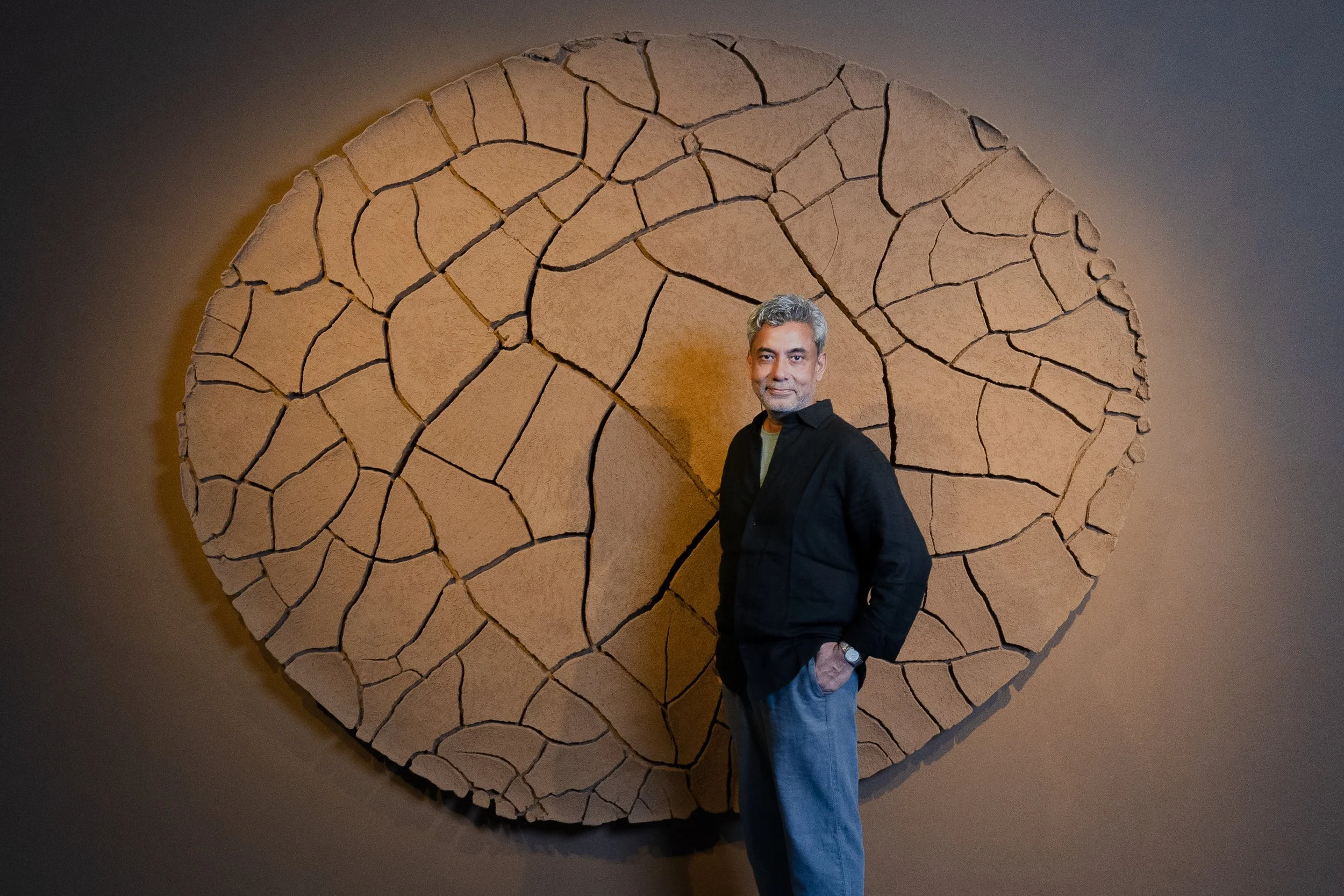
Alwar Balasubramaniam - Not Just For Us [image Joe Habben]

Alwar Balasubramaniam - Not Just for Us [image Andrea Avezzù]
Ranjani Shettar
CWIT Residency 2005
This instinct permeates Ranjani Shettar’s prodigious installation Under the Same Sky. Having more recently witnessed her work suspended amidst the lush, Jurassic foliage of the Barbican Conservatory in London in 2024, standing beneath these gigantic, hovering, ornamental forms in Venice was yet another botanical experience. Meticulously handcrafted by wrapping dyed fabric over bent steel armatures and polishing the surfaces with lacquer, these biomorphic structures unfold their white and yellow blooms in a nocturnal glow. I imagine a phantom scent as we swarm like insects beneath the canopy, made to feel inconspicuously small. Because there is so much pain around," Shettar reflects, "I really wanted to create something that's beautiful. I believe that beauty has the capacity to heal." While the experience of the beautiful affords a respite, one senses an undercurrent of uncertainty, registering the pervasive misgivings of our current global condition.
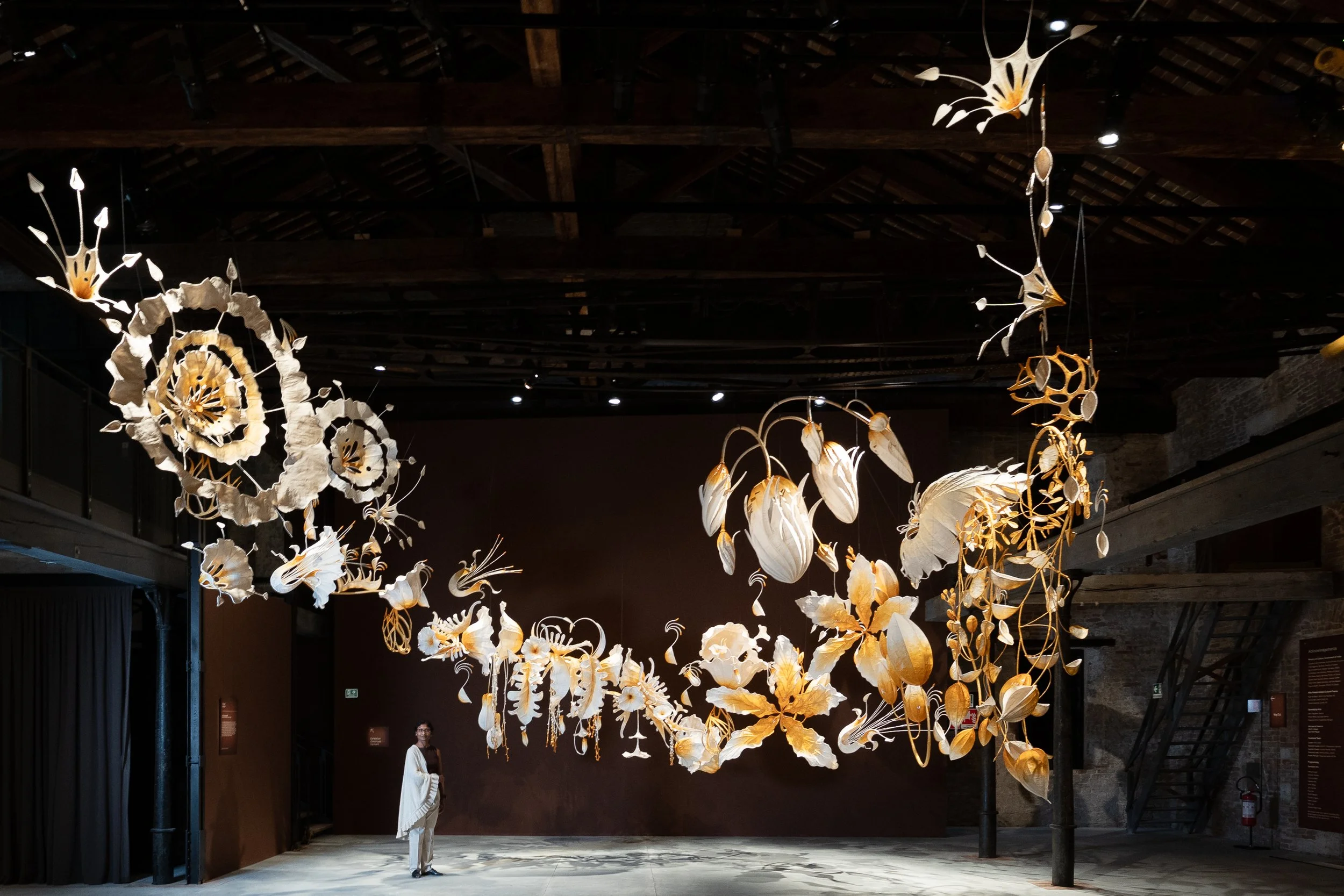
Ranjani Shettar - Under the same sky [image Joe Habben]
Shettar has just returned from another busy day at her studio in Sagara, Karnataka, as she prepares for her upcoming solo exhibition taking place at Talwar Gallery, New Delhi. In 2004, supported by a CWIT fellowship, she spent three months at Gasworks in London. Living and working in the city offered Shettar an encounter with global contemporary art beyond textbooks, demystifying the Western canons she had studied in art school. “Seeing artworks in their flesh and blood was seminal,” she recalls. Returning to the Gasworks studio everyday after being exposed to new materials, conversations, and discourses, provided her the room to experiment, test the boundaries of her practice, and build the confidence to elevate her traditional techniques on an international scale.
“I really wanted to create something that's beautiful. I believe that beauty has the capacity to heal."
Shettar deliberately chooses a language of quietude and sensory contemplation, approaching her practice with ecological responsibility. Rejecting industrial fabrication, Shettar works almost exclusively with organic and ethically sourced earthbound materials, or timber salvaged and repurposed from demolished architecture. By bridging centuries-old artisanal techniques, such as Channapatna lac turnery, hand-carving, and natural vegetable dyeing, with monumental spatial installation, she makes a purposeful political assertion through sheer physical labour. "I could very well have used mill-made fabric, but choosing hand-woven fabric is a subtle, political choice," she explains, affirming the autonomy of traditional craft to hold its own alongside fast-moving trends of global contemporary art.
"I could very well have used mill-made fabric, but choosing hand-woven fabric is a subtle, political choice,"
Listening to them as an early-career curator and writer and reflecting on my own journey as a Charles Wallace scholar, offered an insightful perspective on how artistic practices evolve over time. Bala compares the life of an artist to navigating an open ocean: a constant search across unfixed waters towards an uncertain shore, away from our own places of origin. For him, as for so many of us who has made that journey, the scholarship offered a shelter, to then allow a practice to follow its own direction. These early professional grants are the baseline infrastructure that enables artists to find their footing. Giving creatives that kind of uninterrupted time and space is what sustains a career over decades, and we need far more of these generous opportunities made possible across the wider art ecosystem.

Ranjani Shettar - Under the same sky [image Andrea Avezzù]
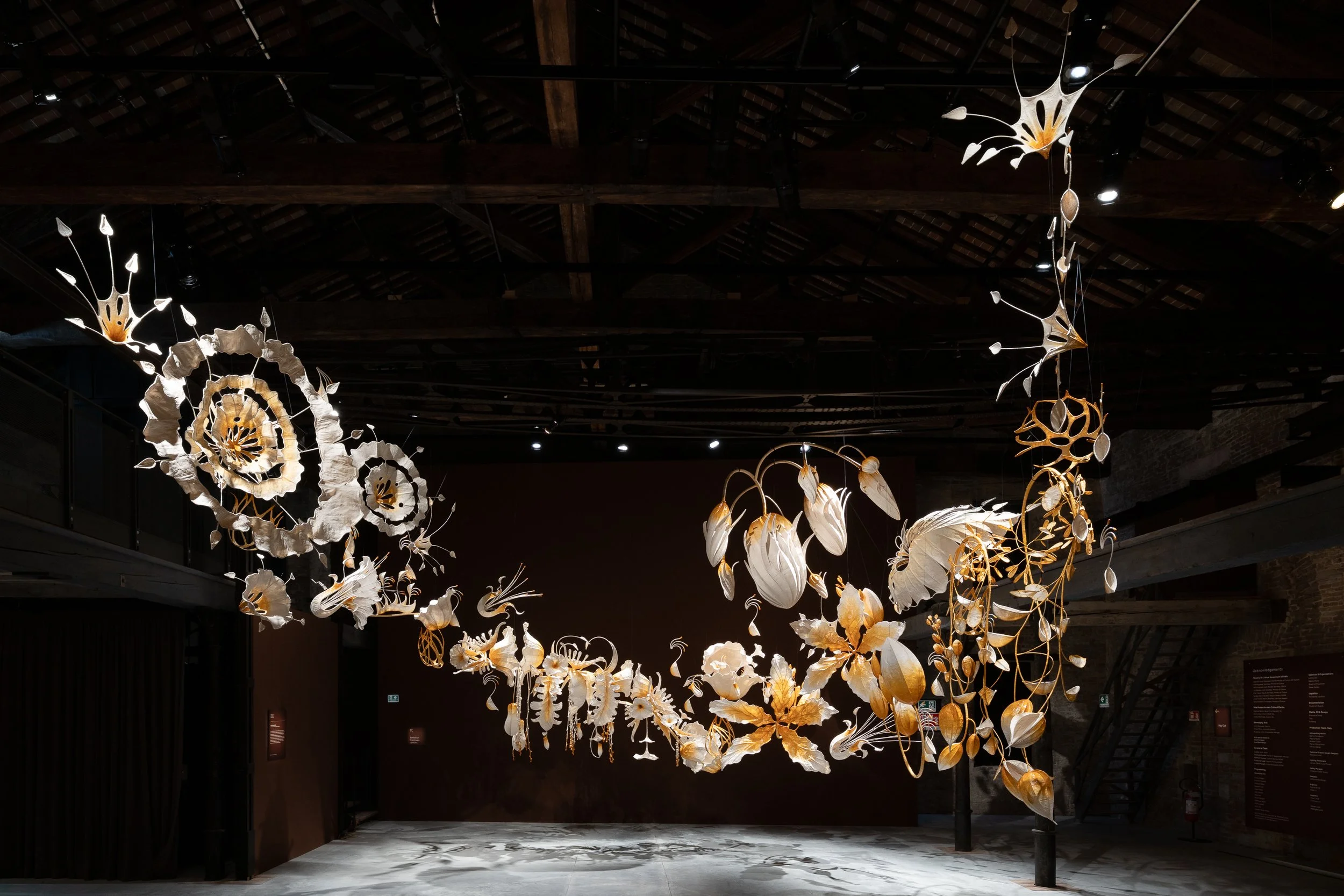
Ranjani Shettar - Under the same sky [image Andrea Avezzù]
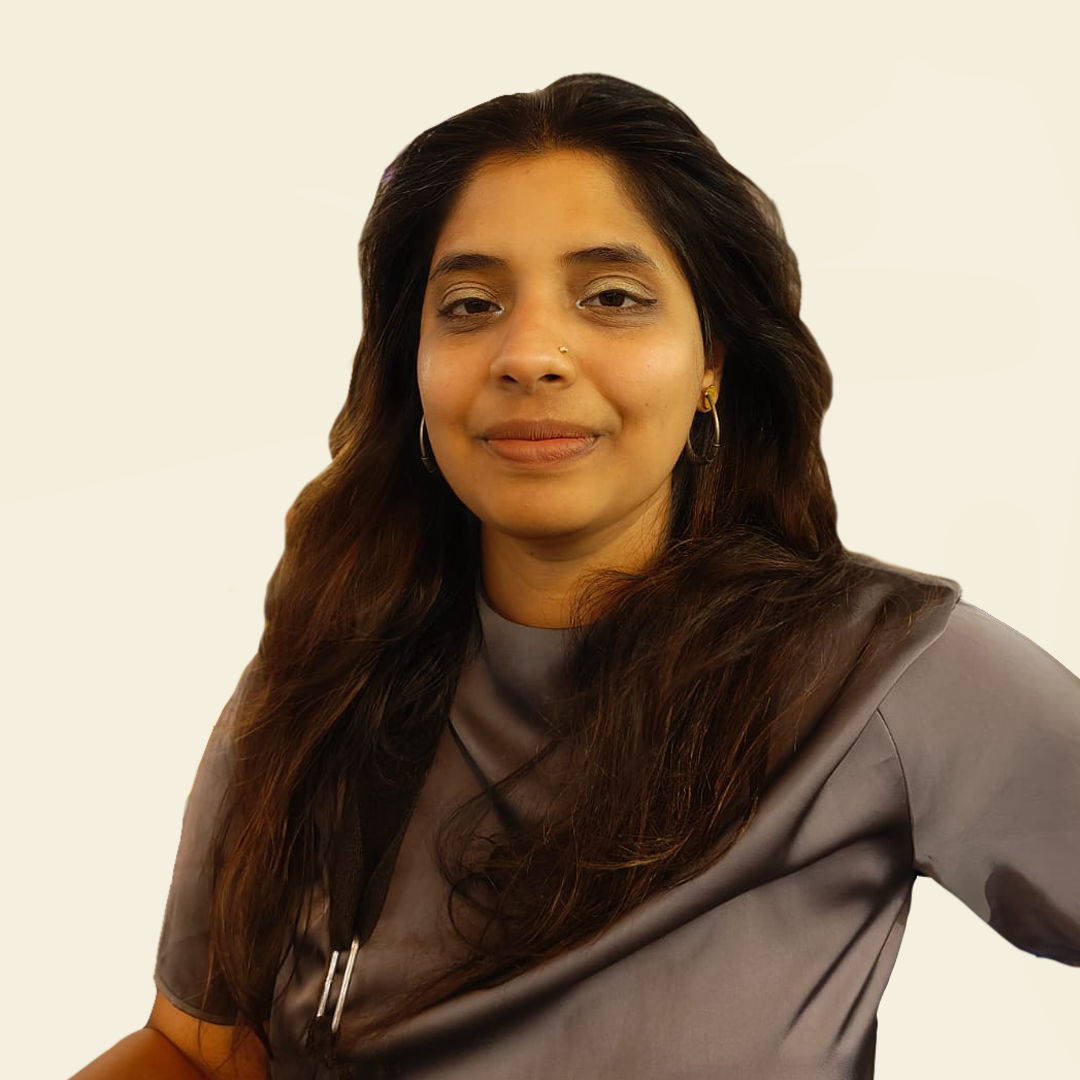
Shalmali Shetty is an independent curator and writer based in Glasgow, working between the UK and India. As a Charles Wallace India Trust Scholar (2019-2020), she completed an MLitt in Curatorial Practice at the Glasgow School of Art. Her research interests include themes of archives, memory, hauntology and material culture studies. She currently serves on the Board of Trustees for the Scottish Contemporary Art Network (SCAN) and regularly contributes writing to various contemporary art publications.
WWW: shalmalishetty.wordpress.com Instagram: @shalmali9